


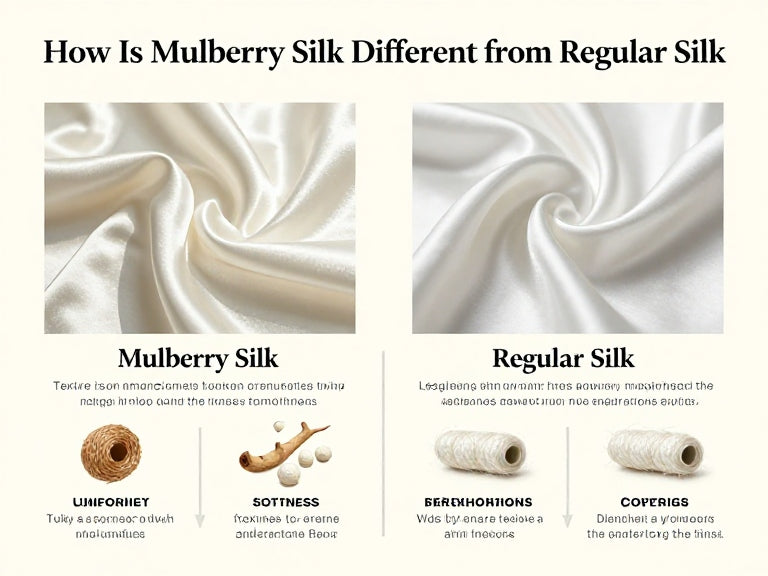
Mulberry silk is a type of real silk, not a synthetic alternative or a separate fabric category. The main difference is where the silkworms get their food and how consistently the resulting fibers can be produced. Mulberry silk comes from silkworms primarily raised on mulberry leaves, while the term “regular silk” is often used loosely to describe other silk varieties, mixed-quality silk, or silk products without a clearly stated source.
That distinction matters when you are choosing a pillowcase, duvet, sleep mask, or other item that stays close to your skin. A well-made mulberry silk product can offer a smooth, consistent surface and reliable comfort. But the words “mulberry silk” alone do not guarantee superior quality. Fiber grade, construction, fabric weight, finishing, and honest product labeling all matter.

Mulberry silk is generally more uniform, smooth, and consistent because it is produced by domesticated silkworms raised on a controlled diet of mulberry leaves. “Regular silk” is not a precise technical grade: it may refer to tussah or other wild silks, or simply to silk without a specified source. For pillowcases and sleep accessories, we recommend checking the fiber content, silk grade, fabric weight, and construction rather than buying based on the word “silk” alone.
- What is mulberry silk?
- What does regular silk mean?
- 7 key differences between mulberry silk and regular silk
- Mulberry silk vs. regular silk comparison table
- Benefits and limitations of mulberry silk
- Does silk grade matter?
- What to check before buying
- Which silk should you choose?
- How to care for silk
- A practical silk essentials option from Souverhome
- Frequently asked questions
- References
What Is Mulberry Silk?
Mulberry silk is a natural protein fiber produced by the domesticated silkworm Bombyx mori. These silkworms are commonly raised in controlled sericulture environments and fed primarily with mulberry leaves. Their cocoons produce long, fine filaments that can be reeled and processed into silk yarn.
The controlled rearing process is important. When silkworms receive a relatively consistent diet and are raised under managed conditions, producers can obtain fibers with more predictable characteristics. The resulting silk is valued for its smooth hand feel, natural sheen, fine texture, and ability to be woven into lightweight yet comfortable fabrics.
Mulberry silk is widely used in premium bedding, pillowcases, sleep masks, scarves, and clothing. It is especially relevant for products that touch the face or hair for several hours at a time.
How is mulberry silk made?
The process begins with silkworm eggs, which hatch into larvae. The larvae feed on mulberry leaves as they grow. Once mature, they spin cocoons made from continuous silk filaments. These cocoons are harvested and processed so the filaments can be reeled into yarn. The yarn is then woven or knitted into fabric, dyed or finished as required, and made into finished products.
Not every stage produces identical results. Cocoon condition, reeling technique, filament selection, yarn preparation, weaving density, dyeing, and finishing can all affect the final fabric. This is why two products described as mulberry silk may feel and perform differently.
What Does “Regular Silk” Mean?
“Regular silk” is a broad consumer phrase, not a reliable fiber classification. It can mean different things depending on the seller. One product may be made from genuine non-mulberry silk, another from a blend, and another from mulberry silk that is simply not marketed with a grade or detailed specification.
One common comparison is between mulberry silk and wild silk, such as tussah silk. Wild silkworms generally feed on leaves from trees or plants in their natural environment rather than being raised on a controlled mulberry diet. Their fibers can have a different appearance and texture, often with a more irregular surface and a less uniform color.
Neither category is automatically fake or inferior. Wild silk can be attractive and appropriate for textured textiles, decorative fabrics, and certain clothing applications. However, if your priority is a consistently smooth surface for bedding or a sleep mask, mulberry silk is usually the more predictable choice.
7 Key Differences Between Mulberry Silk and Regular Silk
1. Silkworm species and feeding environment
Mulberry silk is associated with domesticated Bombyx mori silkworms, which are raised mainly on mulberry leaves. Wild silk varieties come from other silkworm species and may be produced in less controlled natural environments.
This difference influences the fiber characteristics. Controlled rearing generally supports more consistent raw material, while wild silk can vary more in color, thickness, and texture. If consistency is important across a matching bedding set, that predictability is a meaningful advantage.
2. Fiber uniformity and texture
Mulberry silk filaments are typically fine and relatively uniform. This makes it possible to produce fabrics with a smooth, even surface. Wild silk often has more variation in filament characteristics, which can create a slightly coarser or more textured feel.
For a decorative cushion or textured garment, that variation may be desirable. For a pillowcase that your cheek touches every night, we would generally prioritize a smoother, more consistent fabric.
3. Appearance and natural sheen
Mulberry silk is known for its soft, refined sheen. Depending on the weave and finishing, it can look lustrous without appearing excessively glossy. Some wild silks have a more matte, irregular, or earthy appearance.
However, shine is not a dependable quality test. Chemical finishing, fabric construction, lighting, and photography can all change how silk looks. A highly glossy product is not necessarily made from better silk.
4. Strength and durability
Silk is a natural protein fiber with useful tensile properties, but durability depends on more than the silk variety. Filament quality, yarn construction, fabric weight, weave density, seam quality, and care all affect how long a finished item lasts.
Long, continuous filaments can be used to create smooth yarns with fewer interruptions. This is one reason high-quality mulberry silk is popular in premium bedding. Still, a poorly sewn mulberry silk pillowcase can wear out sooner than a well-constructed product made from another suitable textile.
5. Comfort and breathability
Silk fabrics are generally lightweight and can feel comfortable across different seasons. Their smooth surface and drape are part of their appeal in sleep products. Mulberry silk's uniform fibers can help create a consistent fabric feel, but comfort also depends on the weave, fabric weight, room temperature, and personal preference.
Do not assume that every silk item is automatically cooler than cotton or more comfortable for every sleeper. A tightly woven or heavily finished fabric may feel different from a lightweight silk charmeuse. For bedding, consider the complete construction rather than fiber name alone.
6. Price and availability
Premium mulberry silk products can cost more than many basic textile alternatives because of raw material selection, processing, fabric construction, and finishing. Wild silk products may be priced differently depending on availability, processing difficulty, and design.
Price alone does not prove quality. A high-priced item may include branding or elaborate packaging, while a reasonably priced product may offer good value if its fiber content and construction are clearly specified. Compare like with like: fiber composition, fabric weight, dimensions, stitching, and care instructions.
7. Suitability for bedding and personal accessories
Mulberry silk is a strong choice for pillowcases, sleep masks, and other products where a smooth, consistent surface is a priority. It is also used in duvet covers and other premium bedding.
Wild silk may be a better fit when the goal is a distinctive texture, natural variation, or a more rustic visual effect. The right choice depends on the application, not on a simple ranking that says one silk is always better than another.
Mulberry Silk vs. Regular Silk: Comparison Table
| Feature | Mulberry Silk | Other or “Regular” Silk | What It Means for Buyers |
|---|---|---|---|
| Fiber source | Usually domesticated Bombyx mori | May include wild silk varieties or unspecified silk | Confirm the actual fiber type before comparing |
| Silkworm diet | Primarily mulberry leaves | Varies by species and environment | Diet and rearing conditions affect fiber consistency |
| Texture | Typically smooth and uniform | Can be more varied or textured | Mulberry is often preferable for face-contact products |
| Appearance | Often has a refined natural sheen | May be more matte or irregular | Appearance alone cannot verify authenticity |
| Consistency | Generally more predictable | Can vary considerably | Useful when buying matching bedding pieces |
| Common applications | Bedding, pillowcases, sleep masks, apparel | Apparel, decorative textiles, specialty fabrics | Choose according to texture and intended use |
| Price | Often positioned in the premium segment | Varies by type and processing | Compare specifications, not just price |
| Care | Usually requires gentle care | Depends on the specific silk and construction | Always follow the item's care label |
Benefits and Limitations of Mulberry Silk
Mulberry silk is worth considering when its specific qualities solve a real need. It is not automatically the best fabric for every product, every budget, or every household. The following pros and cons are the points we would weigh before recommending it.
| Pros | Cons |
|---|---|
| Smooth, refined surface that many people prefer for pillowcases and sleep accessories | Usually costs more than basic cotton or polyester alternatives |
| Fine, relatively uniform fibers support consistent fabric construction | Quality varies; the mulberry label alone does not guarantee premium workmanship |
| Lightweight drape and natural sheen suit premium bedding and accessories | Can require more careful washing and storage than robust everyday fabrics |
| Natural protein fiber rather than a conventional petroleum-based synthetic | Not automatically hypoallergenic or suitable for every sensitive user |
| Works well across coordinated products such as pillowcases, masks, and scrunchies | Can be damaged by harsh detergents, high heat, abrasion, or unsuitable care |
What are the practical benefits?
- Smoother contact: A well-made mulberry silk fabric can feel gentle against the face and hair.
- Consistent finish: More uniform fibers can support a refined, even textile surface.
- Lightweight comfort: Silk is valued for its drape and comfortable feel in sleep accessories and bedding.
- Coordinated use: Pillowcases, eye masks, and scrunchies can provide a consistent material experience.
What are the limitations?
- Care is important: Silk can be vulnerable to strong detergents, bleach, excessive heat, and rough handling.
- Quality claims need verification: “Premium,” “luxury,” and even a stated grade should be supported by clear specifications.
- Benefits should not be exaggerated: Silk is not a medical treatment for acne, wrinkles, hair loss, or allergies.
- Value depends on use: If you prefer crisp, low-maintenance bedding, cotton may be a more practical choice.
Does Mulberry Silk Grade Matter?
Yes. Once you have confirmed that a product is genuinely made from mulberry silk, grade and fabric construction become important buying considerations. You may see grades such as 6A, 5A, or lower grades in product listings. These labels are commonly used in the silk trade to communicate aspects of raw silk quality, but buyers should not assume that every seller applies an identical grading system or that a grade describes the complete finished product.
Grade can provide useful information about the selected silk material, but it does not independently tell you the fabric weight, weave, finishing quality, stitching, or durability of a finished pillowcase. A 6A claim is not a substitute for transparent product specifications.
For a closer explanation, read our guide to mulberry silk grades and quality and our breakdown of what 6A mulberry silk means.
Is 6A mulberry silk always the best choice?
It can be a strong quality indicator when the claim is genuine and supported by the supplier. However, we would not pay a premium for the grade label alone. Ask for the exact fiber composition, fabric weight, construction details, and care instructions. If the seller cannot explain these basics, the grade claim should carry less weight in your decision.
What to Check Before Buying Mulberry Silk
For most buyers, the best way to avoid disappointment is to assess the complete product rather than focus on one marketing phrase. These are the checks we recommend before spending more on silk bedding or accessories.
1. Verify the fiber content
Look for a clear statement such as “100% mulberry silk.” Be cautious with vague phrases such as “silky feel,” “silk touch,” or “silk-like.” These may describe the texture rather than the fiber composition. If the listing says “silk blend,” check what the other fibers are and how much of the product they represent.
2. Check the fabric weight and construction
For silk bedding, momme (mm) is commonly used as a fabric-weight measure. It is useful for comparing silk fabrics, but it is not a direct grade of fiber purity or a universal durability score. Compare products with similar construction and intended use. A pillowcase and a lightweight scarf should not be judged by the same target specification.
Ask whether the fabric is woven silk, what type of weave is used, and whether the product has a lining or additional layers. For a pillowcase, inspect the closure, seams, and internal finishing. For a duvet cover, check the corner ties, closure system, and dimensions.
3. Understand the product's intended use
A pillowcase needs to withstand regular contact and repeated laundering. A sleep mask needs a comfortable fit, smooth lining, and a secure but gentle strap. A duvet cover needs suitable dimensions, reliable closures, and practical construction. The same silk specification will not automatically deliver the same value across these different products.
4. Review care instructions
Check whether the item is hand-washable or machine-washable under specific conditions. Do not assume that all silk products can be washed in the same way. A washable claim should include practical instructions, such as using a delicate cycle, cool water, and a suitable detergent if machine washing is permitted.
5. Evaluate the seller's transparency
Reliable sellers should be able to explain fiber composition, product dimensions, fabric weight where relevant, country of manufacture where disclosed, and care requirements. Clear return policies and realistic product photographs also help. Be wary of listings that use luxury language but provide almost no measurable details.
6. Compare total value, not the lowest price
A cheaper pillowcase may be attractive initially, but poor stitching, unclear fiber content, or difficult care can reduce its value. At the same time, a premium price does not guarantee a better night's sleep. Compare the specifications and construction of products in the same category before deciding.
Which Silk Should You Choose? Practical Recommendations
For pillowcases and everyday sleep comfort
Choose a well-constructed mulberry silk pillowcase if you value a smooth surface and a refined feel against your face and hair. Check the fabric weight, closure, seams, and washing instructions. Our mulberry silk pillowcase is a relevant option to consider when building a silk sleep setup.
If you are comparing several styles, our guide to top silk pillowcases can help you evaluate product features. For skin-focused shopping, see our guide to silk pillowcases for skin and hair. Remember that a silk pillowcase may reduce some friction compared with rougher fabrics, but it should not be presented as a treatment for acne or a proven way to prevent wrinkles.
For people who wear a sleep mask
A mulberry silk eye mask makes sense if you want a soft fabric against the delicate eye area. Prioritize a comfortable shape, a strap that does not pull, and a lining that does not irritate your skin. A mask that presses too firmly or lets in too much light is not a good purchase simply because it uses premium silk.
Explore the mulberry silk sleep eye mask if this is the accessory you use most often.
For hair accessories
Silk scrunchies are worth considering for people who tie their hair back frequently and want a smooth fabric alternative to elastic bands with rough seams. The right fit matters: a scrunchie that is too tight can still pull hair, regardless of its material. A silk large scrunchie can be a practical addition to a coordinated sleep and hair-care routine.
For full bedding upgrades
If you want a consistent material experience, it may be more useful to upgrade the pillowcase first and assess whether you enjoy the feel before replacing an entire bedding set. For a broader selection, browse the silk bedding collection.
For warmth and bedding insulation, compare the construction and fill of a duvet rather than assuming that a silk cover alone will make a bed warmer. Souverhome's all-season silk-filled duvet is a separate bedding option designed around silk filling.
Mulberry Silk vs. Cotton, Satin, and Polyester: Which Is Better?
Mulberry silk is not the only reasonable choice for bedding. Cotton is practical and familiar, satin describes a weave rather than a fiber, and polyester can offer a low-cost smooth surface. The right comparison depends on whether you prioritize natural fiber content, easy care, price, or tactile feel.
| Material | Main Advantage | Main Trade-Off | Best For |
|---|---|---|---|
| Mulberry silk | Natural protein fiber with a smooth, refined feel | Higher price and more careful maintenance | Premium pillowcases, sleep masks, and bedding |
| Cotton | Familiar, practical, and available in many constructions | Texture varies; may feel less slippery than silk | Everyday bedding and easy-care households |
| Polyester satin | Often inexpensive and smooth to the touch | Synthetic fiber; feel and breathability vary by construction | Budget-conscious buyers who want a satin finish |
| Silk satin | Combines silk fiber with a satin weave and sheen | Can be more delicate and expensive | Buyers seeking a lustrous silk surface |
| Wild silk | Distinctive natural texture and appearance | May be less uniform than mulberry silk | Textured garments and decorative textiles |
One important clarification: satin is not a fiber. It is a weave structure. Silk satin can be made from silk fibers, while polyester satin is made from polyester. A product described as “satin” is therefore not necessarily silk. Always check the fiber content on the label.
Common Mistakes When Buying Mulberry Silk
- Assuming all silk is mulberry silk. Ask for the specific fiber source instead of relying on a generic silk label.
- Confusing satin with silk. Satin describes the weave, not the material. Polyester satin is not equivalent to mulberry silk.
- Buying based only on 6A claims. Grade is only one part of product quality. Construction and fabric specifications matter too.
- Assuming more shine means better silk. Finishing and lighting can change appearance. Shine is not proof of purity.
- Ignoring seams and closures. A premium fabric with weak stitching can still become an unsatisfactory product.
- Expecting medical results. Silk can feel smooth and comfortable, but it is not a proven cure for acne, eczema, wrinkles, or hair loss.
- Using harsh laundry products. Bleach, strong detergents, high heat, and rough washing can damage delicate silk fibers.
How to Care for Mulberry Silk
Good care protects the fabric and helps preserve its appearance. Always follow the manufacturer's label first, because dye, weave, trims, elastic, and construction can affect the appropriate cleaning method.
- Use a suitable detergent. Choose a gentle detergent intended for delicate fabrics or silk. Avoid bleach and harsh stain removers unless the care label specifically permits them.
- Use cool water. Hot water and aggressive washing can damage or distort delicate silk fabrics.
- Keep washing gentle. If machine washing is allowed, use a delicate cycle and a protective laundry bag. Otherwise, hand-wash according to the label.
- Avoid wringing. Press out excess water gently rather than twisting the fabric.
- Dry carefully. Keep silk away from direct high heat. Follow the care label for flat drying or hanging.
- Store clean and dry. Keep silk products away from damp conditions and prolonged direct sunlight.
For a pillowcase used every night, regular gentle cleaning is more sensible than waiting until visible dirt builds up. A sleep mask and scrunchie should also be washed at intervals appropriate to how often they are used and the manufacturer's instructions.
A Practical Silk Essentials Option from Souverhome
If you are new to silk, we recommend starting with the items that make direct contact with your face and hair rather than immediately replacing every piece of bedding. A coordinated set can also make it easier to assess whether you like the material in everyday use.

Souverhome Mulberry Silk Essentials Bundle
The bundle includes:
- 1 silk pillowcase
- 1 silk eye mask
- 1 silk large scrunchie
It is described as 100% grade 6A mulberry silk with long-fiber construction. The coordinated set is intended for buyers who want to try silk across several everyday sleep and hair accessories.
We see the strongest practical case for this type of bundle when a buyer already wants a silk pillowcase and also uses an eye mask or ties their hair back at night. Buying coordinated pieces can be convenient, but it is not automatically better value than purchasing only the item you need. Compare the bundle price with the individual products and make sure all three accessories suit your routine.
The product description identifies the bundle as 100% 6A mulberry silk and highlights its smooth feel and suitability for regular personal use. Claims such as anti-allergy or wrinkle prevention should be interpreted carefully: individual skin responses vary, and silk accessories should not be treated as medical or dermatological products.
Our Expert Recommendation: Is Mulberry Silk Worth Buying?
For pillowcases, sleep masks, and hair accessories, mulberry silk is worth considering when you value a smooth natural fiber, refined feel, and consistent fabric surface. It is particularly appealing for products that remain in contact with your face or hair for extended periods.
However, we would not recommend paying a premium just because a product uses the words “mulberry silk” or “6A.” Verify the fiber content, ask about fabric weight and construction, inspect the stitching, and check the care requirements. These details have a direct effect on the product you actually receive.
For beginners, start with one pillowcase or sleep accessory. Use it for a few weeks and decide whether the feel and maintenance requirements suit your routine. For commercial users or buyers sourcing silk products in volume, request material specifications, samples, consistency information, and clear labeling before placing a larger order.
Our bottom line: mulberry silk is generally the more predictable option when you want smooth, uniform silk for bedding and personal accessories. But the best purchase is not necessarily the product with the highest grade claim or the highest price. It is the one with verifiable materials, appropriate construction, and a realistic fit for how you will use it.
Frequently Asked Questions
1. Is mulberry silk better than regular silk?
For products where a smooth and consistent texture matters, such as pillowcases and sleep masks, mulberry silk is often the more predictable choice. However, “regular silk” is not a precise technical term. The comparison depends on which silk variety and product construction you are evaluating.
2. Is mulberry silk real silk?
Yes. Mulberry silk is genuine natural silk produced by domesticated Bombyx mori silkworms, which are generally raised on mulberry leaves. It is one of the most widely used silk types in premium textiles.
3. Is 100% mulberry silk worth the extra cost?
It can be worth the extra cost if you value its smooth texture and natural fiber content, particularly in products used every night. The value depends on fabric weight, construction, stitching, and care requirements. Do not rely on the fiber label alone.
4. Is 6A mulberry silk the highest grade?
6A is commonly presented as a top grade in commercial mulberry silk grading descriptions. However, grading practices and claims can vary between sellers. Check the supplier's explanation and the finished product specifications rather than treating the grade as a complete quality guarantee.
5. Does mulberry silk help with hair and skin?
Its smooth surface may reduce friction compared with some rougher fabrics, which some users find more comfortable for hair and skin. It is not a proven treatment for acne, wrinkles, eczema, or hair loss, and results vary from person to person.
6. Is mulberry silk hypoallergenic?
Silk is a natural protein fiber, but no textile can be guaranteed to suit everyone. Sensitivity may relate to dyes, finishes, detergents, dust, or other components of the finished product. If you have a known allergy or skin condition, check the full material details and consult a qualified healthcare professional when appropriate.
7. How can I tell if silk is genuine mulberry silk?
Start with the product label and supplier specifications. Look for a clear 100% mulberry silk fiber-content statement and supporting details about construction and care. Appearance and touch alone cannot reliably establish fiber identity. For higher-value purchases, ask the seller for appropriate material documentation.
8. Is mulberry silk the same as silk satin?
No. Mulberry silk identifies the fiber source, while satin describes a weave structure. A satin fabric can be made from silk, polyester, or another fiber. A product called silk satin should identify silk as its actual fiber content.
9. Can mulberry silk be machine washed?
Some silk products can be machine washed on a delicate cycle, while others require hand washing or professional care. Follow the specific care label. When machine washing is permitted, use cool water, a gentle detergent, and a protective laundry bag.
10. What is the best mulberry silk product to buy first?
A pillowcase is a practical starting point because it is used regularly and gives you a clear sense of whether you enjoy silk's texture. If you already use a sleep mask or tie your hair back at night, a coordinated set may offer better convenience.
References
- Encyclopaedia Britannica – Silk. Background on silk as a natural fiber and its production.
- Food and Agriculture Organization of the United Nations (FAO). Agricultural and sericulture context for silk production and silkworm rearing.
- CottonWorks – Understanding Fiber Properties. General textile-fiber context for evaluating material properties and performance.

Dejar un comentario
Este sitio está protegido por hCaptcha y se aplican la Política de privacidad de hCaptcha y los Términos del servicio.