


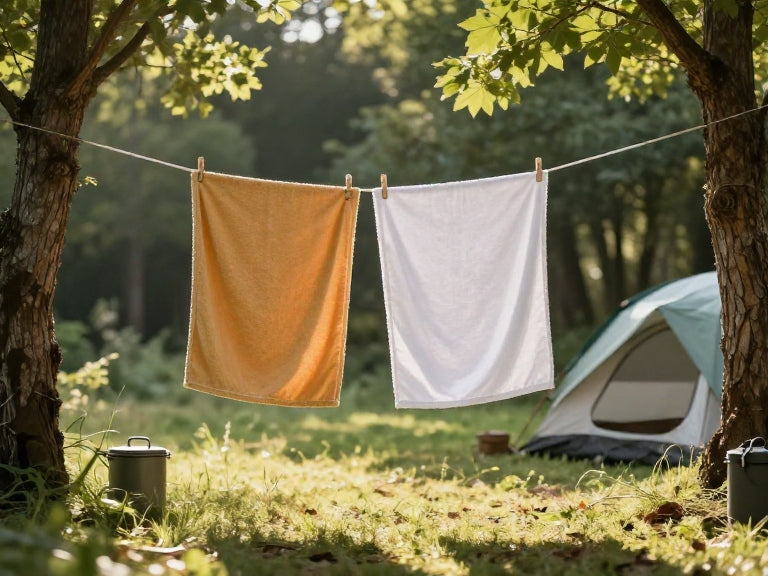
To dry towels while camping, the most reliable approach is to remove as much water as possible first, then hang the towel where it gets moving air, warmth, and enough space to breathe. A towel left folded over a damp tent line or stuffed into a backpack will stay wet far longer than one spread across a ventilated drying line. Weather matters, but how you prepare and position the towel often matters just as much.
Camping creates a simple problem that becomes irritating quickly: you need your towel after swimming, showering, washing up, or getting caught in the rain, but you may not have a tumble dryer, heated bathroom, or even a sunny campsite. A damp towel can become heavy, uncomfortable to reuse, and difficult to pack without transferring moisture to your clothes and sleeping gear.

Our recommendation is straightforward: use a quick-dry microfiber towel for trips where packing space and drying time matter, and combine it with a smart hanging routine. Below are five methods that work in real camping conditions, including rainy weather and campsites where open-air drying is limited.
Direct Answer: What Is the Best Way to Dry Towels While Camping?
The best way to dry towels while camping is to wring or press out excess water, shake the towel open, and hang it fully spread in a breezy, sheltered location. If you have sunlight, use it, but do not rely on direct sun alone. In humid or rainy weather, airflow and separation from other wet equipment become more important than heat.
For frequent campers, a lightweight quick-dry microfiber towel is a worthwhile upgrade over a thick cotton bath towel. Microfiber generally holds less water within its structure after wringing and can dry faster when exposed to suitable airflow. It is not magic: a saturated towel in still, humid air will still take time to dry.
- What it is: A set of practical methods for removing moisture from towels without access to a conventional dryer.
- How it works: Reduce retained water, spread the fabric, and use airflow, sunlight, or gentle warmth to speed evaporation.
- Benefits: Less damp gear, lighter packing, better comfort, and fewer wet items inside your tent or backpack.
- Limitations: Humidity, rain, cold temperatures, and poor ventilation can slow drying considerably.
- Best for: Campers, hikers, backpackers, van travelers, swimmers, and families using shared campsite facilities.
- Who does not need special gear: Occasional car campers with plenty of space and access to a campsite laundry room.
- Common mistakes: Folding a wet towel, hanging it in a closed tent, leaving it bunched up, or packing it before it is dry.
- Buying considerations: Compare material, size, weight, absorbency, hanging loops, storage, and washability.
- Expert recommendation: Choose a lightweight quick-dry towel and pair it with a ventilated hanging routine. Do not depend on sunlight alone.
Quick Summary: Five Methods to Dry Towels While Camping
| Method | Best conditions | Main advantage | Limitation | Our verdict |
|---|---|---|---|---|
| 1. Hang on a camping clothesline | Most weather conditions, especially with a breeze | Allows the whole towel to spread out | Needs a suitable hanging point and enough space | Best all-round method |
| 2. Use direct sunlight | Sunny, dry weather | Combines warmth with natural evaporation | Less effective in shade, cold, or humid weather | Excellent when available |
| 3. Improve airflow | Humid, cloudy, or partly sheltered campsites | Moves moist air away from the fabric | Still air can make drying slow | Essential in poor weather |
| 4. Press and wring out excess water | Immediately after use | Reduces the amount of water that must evaporate | Must be done carefully with delicate fabric | Best first step |
| 5. Use a quick-dry microfiber towel | Backpacking, hiking, and repeated daily use | Lightweight and designed to dry efficiently | Performance depends on fabric quality and conditions | Best equipment upgrade |
Why Do Towels Take So Long to Dry While Camping?
A towel dries when water held in and between its fibers evaporates into the surrounding air. That process depends on several conditions: airflow, temperature, humidity, exposed surface area, and how much water the towel contains. Camping environments often make several of these conditions less favorable at the same time.
High humidity slows evaporation
When the air is already humid, it cannot accept moisture from a wet towel as quickly as dry air can. This is why a towel may remain damp for hours at a coastal campsite, beside a lake, or after overnight rain even when temperatures feel comfortable.
Thick cotton towels hold more water
Traditional cotton bath towels are comfortable and absorbent, but thick pile fabric can retain a substantial amount of water. That makes them less convenient when you have to carry everything in a backpack or dry your gear outdoors. A large cotton towel may also become heavy after a swim or shower.
Poor hanging position traps moisture
A towel folded over a narrow branch or packed tightly between two items has less exposed surface area. The inside layers remain damp because air cannot circulate freely. Hanging a towel in a closed tent can create a similar problem: moisture has nowhere to disperse, and condensation may make the situation worse.
From our experience with travel and quick-dry towel selection, the first improvement should be changing the drying setup before buying more equipment. A well-positioned ordinary towel can dry better than an expensive towel left folded in still air.
Method 1: Hang Towels on a Camping Clothesline

A portable camping clothesline is the most dependable all-round solution. It gives you a dedicated place to hang towels, keeps wet fabric away from sleeping bags and clothing, and makes it easier to expose both sides to moving air.
You do not need a complicated setup. A lightweight cord or adjustable clothesline can be attached between suitable trees, poles, or approved campsite fixtures. If you are camping in a designated site, follow local rules and avoid attaching lines to fragile vegetation or damaging tree bark.
How to do it properly
- Shake the towel open to remove folds and separate the fabric.
- Hang it across the line so that as much surface area as possible is exposed.
- Use clips or a secure loop to prevent the towel from slipping in the wind.
- Leave space between the towel and other wet clothing.
- Turn or reposition the towel periodically if one side remains shaded.
For larger bath towels, avoid folding the fabric into several thick layers. If the line is short, hang the towel diagonally or use two attachment points to keep it open.
When this method works best
A clothesline works well at established campsites, family camping areas, and longer stays where you have a stable place to dry gear. It is less convenient during fast-moving backpacking trips, where carrying extra cord and clips may feel unnecessary. A towel with an integrated hanging loop can solve much of that problem.
Our recommendation: If you camp regularly, pack a compact line and a few lightweight clips. They are inexpensive, useful for more than towels, and often make a bigger difference than buying a more expensive drying accessory.
Method 2: Use Direct Sunlight Strategically
Sunlight can speed up towel drying by warming the fabric and supporting evaporation. It is particularly useful after swimming, showering, or washing up on a dry summer day. However, sunlight should be treated as an advantage rather than the entire drying strategy.
Choose the right position
Hang the towel in an open area where it receives sunlight without being exposed to unnecessary dirt, vehicle spray, or foot traffic. A location with both sun and a gentle breeze is usually more effective than a completely sheltered sunny corner.
Keep the towel away from cooking smoke, fire pits, muddy ground, and areas where insects or animals may come into contact with it. If you are camping in a public area, secure it well so it does not blow away.
Do not leave the towel in direct sun indefinitely
Some fabrics and dyes can fade with prolonged ultraviolet exposure. For routine drying, use the sun when it is available, then move the towel to a ventilated shaded area if it is nearly dry. Follow the towel manufacturer's care instructions, especially for microfiber products.
For a practical camping routine, hang the towel in the sun after morning use and check it before packing. If the air is humid or the towel is thick, it may still need more time in a breezy location.
Best for: Summer camping, dry climates, beach trips, and campsites with open space.
Method 3: Maximize Airflow Around the Towel
Airflow is often more important than campers expect. Moving air carries moisture away from the surface of the fabric, allowing evaporation to continue. This is particularly valuable when the weather is cloudy or humid and direct sunlight is limited.
Hang the towel where air can reach both sides
A towel hanging flat against a tent wall will not dry as effectively as one suspended with space around it. Avoid placing it between tightly packed equipment or behind a closed vehicle door. Choose a ventilated position where air can move around the fabric.
Use sheltered airflow in windy conditions
A strong gust can blow a towel off a line or send it into dirt. Instead of choosing the windiest part of the campsite, use a sheltered location with steady air movement. Secure the corners with clips or use the towel's hanging strap.
Can you dry a towel inside a tent?
Only as a temporary fallback, and only when ventilation is adequate. Wet fabric releases moisture into the tent, which can contribute to condensation. That is especially undesirable when sleeping bags, clothing, and other gear need to stay dry.
If outdoor drying is impossible, hang the towel near a vent or in a designated gear area with good airflow. Do not cover tent ventilation openings or place wet fabric against sleeping equipment.
Method 4: Remove Excess Water Before Hanging
The fastest way to reduce drying time is to remove water before evaporation begins. A towel that has been properly wrung out has less moisture to release into the air, which can make a noticeable difference when campsite conditions are poor.
Use a controlled wringing technique
- Hold the towel over a suitable drainage area.
- Fold it loosely into a manageable length.
- Press and squeeze along the fabric to remove excess water.
- If the material allows it, gently wring the towel without twisting it aggressively.
- Shake it open before hanging so the fibers and surface are exposed to air.
For microfiber towels, firm pressing and squeezing are usually preferable to aggressive twisting. Excessive force can stress seams and reduce the life of the product. Follow the manufacturer's care instructions for the specific fabric.
Use a dry towel to press out additional moisture
If you have a second dry towel, you can place the damp towel between dry sections and press them together. This transfers some moisture to the dry fabric. It is not always practical for backpackers carrying minimal gear, but it can help families or car campers who have spare towels.
Why this method matters in rainy weather
When the air is saturated, evaporation becomes slow. Removing water mechanically reduces the amount that needs to evaporate. It will not make a wet towel instantly dry, but it is a useful first step before using a sheltered clothesline or ventilated drying area.
Our recommendation: Make water removal part of your routine every time you finish using a towel. It costs nothing, takes very little time, and improves every drying method that follows.
Method 5: Switch to a Quick-Dry Microfiber Towel
If you camp often, changing the towel itself can be the most useful upgrade. Quick-dry microfiber towels are designed to be lightweight, absorbent, and easier to pack than many traditional thick cotton bath towels. They are particularly suitable for backpacking, hiking, swimming, and trips where you need to reuse a towel over several days.
Microfiber is not automatically better for every person. Some campers prefer the familiar feel of cotton, especially at a vehicle-accessible campsite where weight and drying time are less important. But if you regularly struggle with damp towels in a small tent or backpack, a quality quick-dry towel is worth considering.
Why microfiber is useful for camping
- Lower packed weight: A lightweight towel is easier to carry on hiking and backpacking trips.
- Compact storage: It takes up less space than many thick bath towels.
- Moisture management: Microfiber can absorb water while remaining relatively lightweight.
- Faster drying potential: Its fabric construction and lower bulk can make drying more convenient in suitable conditions.
- Versatile use: A larger towel can handle showers and swimming, while a smaller towel can be used for hands and quick cleanups.
Choose the right size for your trip
For backpacking, a compact towel may be sufficient for wiping down after a swim or washing at a trail facility. For family camping or regular showers, a larger bath towel is more comfortable. A two-piece set can be practical because the larger towel handles bathing while the smaller towel stays available for hands, face, or general campsite use.
For more detailed product selection, see our guide to the best quick-dry towels for camping. If you are comparing materials, our article on the main types of fast-drying towels explains the differences between common towel constructions.
Which Method Is Best for Drying Towels While Camping?
There is no single method that works equally well in every climate. The best result usually comes from combining two or three methods. For example, press out excess water, then hang the towel on a line where it receives moving air and some sunlight.
| Method | Drying support | Equipment needed | Works in rain? | Best use |
|---|---|---|---|---|
| Camping clothesline | High when positioned well | Line and optional clips | Only under suitable shelter | Regular campsite drying |
| Direct sunlight | High in warm, dry weather | None beyond a hanging point | No, unless protected | Sunny daytime conditions |
| Airflow and ventilation | High when air is moving | Hanging space; optional fan in suitable settings | Yes, under cover | Cloudy or humid weather |
| Wringing and pressing | Reduces initial water content | None | Yes | First step in any conditions |
| Quick-dry microfiber towel | Can reduce drying time and packing bulk | Suitable towel | Still needs airflow to dry | Backpacking and repeated use |
For most campers, the best combination is method four followed by method one or three. If the weather is sunny, add method two. If you camp frequently or carry your gear on foot, method five is the upgrade that makes the entire routine easier.
How to Dry Towels While Camping in Rainy or Cold Weather
Rain and cold temperatures make outdoor drying harder, but they do not mean a towel must remain wet until you get home. The goal is to protect the towel from additional moisture while creating as much ventilation as possible.
Use a covered but ventilated area
A covered picnic shelter, awning, or ventilated porch can protect the towel from rain while allowing air to circulate. Avoid completely enclosed spaces where moisture becomes trapped. If the towel is hanging under a tarp, leave enough open space around it for airflow.
Keep wet towels away from sleeping gear
Do not hang a dripping towel directly above your sleeping bag or store it against spare clothing. Even if the towel does not leak, moisture can transfer to nearby fabric. Keep wet gear in a separate area and maintain ventilation inside the tent.
Use a battery-powered fan only where practical
At a powered campsite or in a suitable vehicle setup, a small fan can help move air around a towel. It does not need to blow directly at the fabric from a few inches away; the objective is to prevent a stagnant layer of humid air from sitting around it. Keep electrical equipment dry and follow the manufacturer's safety instructions.
Pack a damp towel separately if it cannot dry completely
Sometimes the weather simply does not cooperate. If you must leave the campsite before the towel dries, avoid packing it loosely with clean clothing. Store it separately in a breathable or moisture-contained compartment appropriate for the journey, then take it out to dry as soon as conditions allow. Do not leave a damp towel sealed in a bag for an extended period.
How to Choose the Best Towel for Camping
A camping towel should be judged by more than how quickly it dries in a product demonstration. It needs to absorb enough water, pack efficiently, feel comfortable against the skin, and survive repeated washing. A towel that dries quickly but is too small or unpleasant to use will not be a good purchase.
1. Material and construction
Microfiber is a strong option for lightweight travel and camping. Cotton is comfortable and familiar but often bulkier and slower to dry, especially in thick bath-towel formats. Some blended fabrics aim to balance softness and drying performance. Compare the actual construction rather than relying only on labels such as “ultra quick dry.”
2. Size and absorbency
Choose a size that matches how you use a towel. A compact hand towel is useful for washing up, but it may not be comfortable after a full shower. A larger bath towel is more versatile but takes up more room. For couples or families, a set with separate large and medium towels can be easier to manage.
3. Weight and packed size
For backpackers, every item competes for space and carrying capacity. Check the actual product weight rather than assuming that all microfiber towels are equally light. Car campers can usually prioritize comfort and size more heavily.
4. Hanging features
A hanging loop, elastic strap, or secure corner tab is more useful than it sounds. It allows the towel to be attached to a line, hook, or suitable campsite fixture without improvising a knot. A storage pouch can also keep the towel organized when it is clean and dry.
5. Durability and care
Check the edge finishing, stitching, washing instructions, and whether the towel is suitable for repeated machine washing. Camping gear is handled more roughly than a towel kept in a bathroom. Strong seams and a secure edge help the towel hold its shape through regular use.
6. Hygiene and drying between uses
Do not confuse a product's antibacterial or odor-control claims with a substitute for washing. Any towel used repeatedly should be cleaned according to its care instructions and dried thoroughly between uses. If a towel develops a persistent musty smell, wash it properly rather than masking the odor with fragrance.
For a broader comparison of travel-friendly options, read our guide to quick-dry towels for travel. If you want a towel that can also work for everyday bathing, our fast-drying bath towel guide covers larger formats.
Souverhome Quick Dry Towel Premium Set: A Practical Camping Option
For campers who want a coordinated large-and-medium towel combination, the Souverhome Quick Dry Towel Premium Set is worth considering. Its microfiber construction and two-size format make it suitable for trips where you want a larger towel for bathing and a second towel for hands or smaller drying tasks.
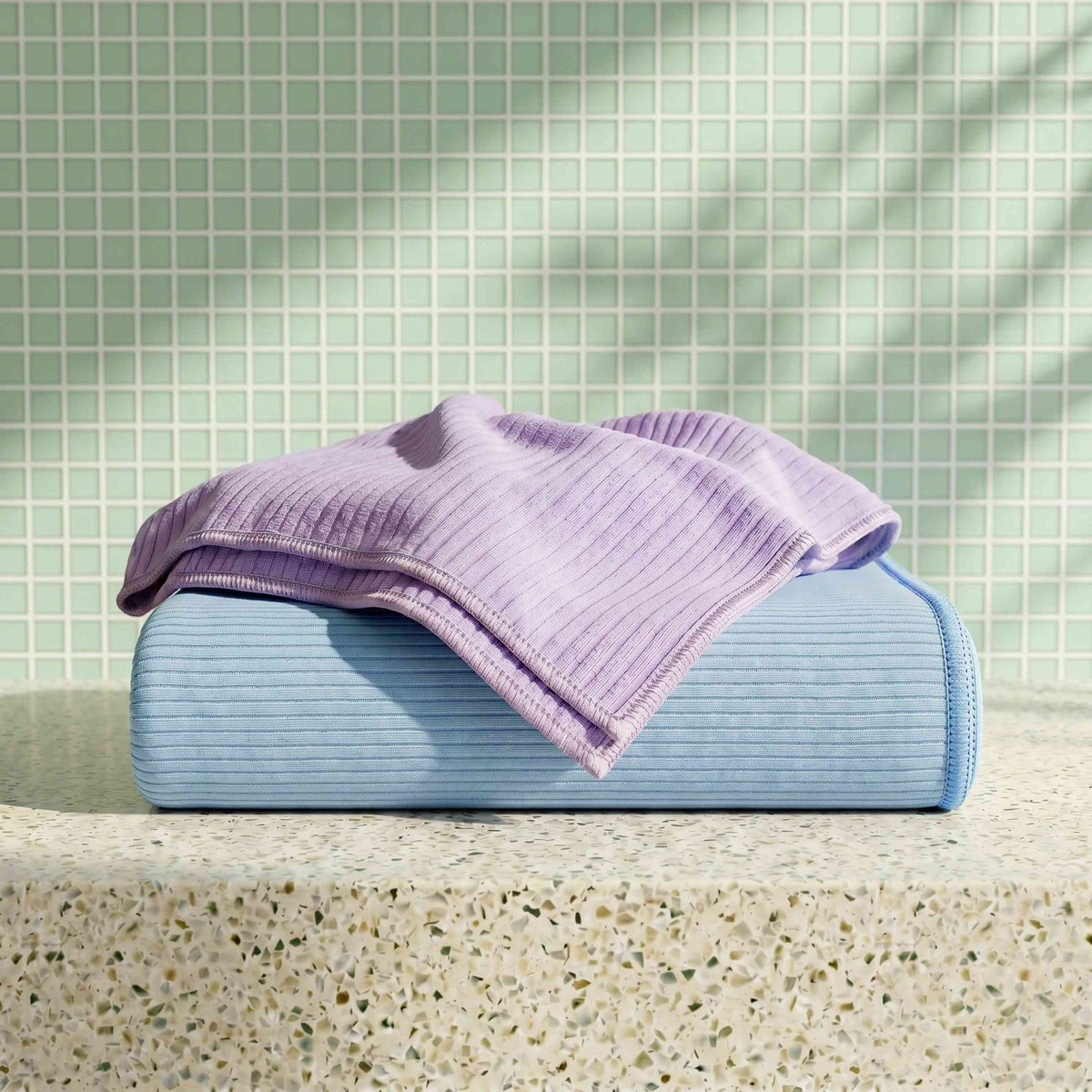
Quick Dry Towel Premium Set
A two-piece microfiber towel set designed for convenient drying, portability, and everyday use at home or while traveling.
- Material: Microfiber
- Large towel: 31.5 × 51 in (80 × 130 cm)
- Medium towel: 31.5 × 23.5 in (80 × 60 cm)
- Set weight: 300 g
- Color combination: Blue Sky and Lilac
- Features: Dense microfiber, absorbent construction, soft feel, lightweight portability, and elastic strap
- Included: Portable storage bag
Why this set makes sense for camping
The main advantage is the combination of two practical sizes. The large towel can be used after a shower or swim, while the medium towel is useful for hands, face, or smaller cleanup tasks. That reduces the need to use one large towel for every job.
The 300 g set weight is also worth noting for campers who want to keep their gear compact. The elastic strap and storage bag help with organization, while the microfiber construction is suited to a quick-dry routine when the towel is hung with adequate airflow.
Who should consider it?
This set is a sensible option for car campers, travel users, couples who want two sizes, and people who use campsite showers. Backpackers who count every gram should compare the total 300 g set weight with their preferred single compact towel. If you only need a small face towel, buying a two-piece set may be unnecessary.
Our recommendation is to choose this kind of set when versatility matters more than carrying the absolute minimum. The large towel is more practical for bathing, and the smaller towel gives you a separate option for routine campsite tasks.
Common Mistakes That Keep Camping Towels Wet
- Leaving the towel folded over itself. Thick overlapping sections trap moisture. Spread the towel out as much as possible.
- Hanging it inside a closed tent. Poor ventilation slows evaporation and can increase condensation. Use an outdoor sheltered area when possible.
- Relying only on sunshine. Air movement matters. A breezy shaded spot may outperform a still, sunny location.
- Putting it straight into a backpack. A damp towel can transfer moisture to clothing and sleeping gear. Dry it first or isolate it for transport.
- Buying a towel that is too large for the trip. A thick oversized towel may be comfortable at home but inconvenient for backpacking.
- Ignoring the care label. High heat, fabric softeners, or unsuitable washing methods can affect some microfiber products. Follow the manufacturer's care instructions.
- Using one towel for every task. A separate small hand towel can keep the main bath towel cleaner and reduce how often it becomes completely saturated.
- Storing a damp towel for too long. Take it out and let it dry as soon as possible. Do not leave it sealed in a bag for days.
Pros and Cons of Quick-Dry Towels for Camping
| Pros | Cons |
|---|---|
| Generally lighter and more compact than thick cotton bath towels | Some microfiber fabrics feel different from traditional cotton |
| Can dry efficiently when spread out with good airflow | Still dries slowly in cold, humid, or stagnant air |
| Useful for repeated use on multi-day trips | Requires proper washing and complete drying between uses |
| Convenient for swimming, hiking, showers, and travel | Very small models may not provide enough coverage |
| Easy to pack in a dedicated pouch | Quality varies; poor edge finishing can reduce durability |
| Two-size sets offer separate bathing and hand-drying options | A set may be unnecessary for minimalist solo backpackers |
Quick-dry towels are worth buying if you camp often, travel with limited luggage, or need to reuse a towel over several days. They are less essential for occasional car campers who have plenty of space and access to laundry facilities. The right choice depends on how much weight, space, and drying time matter on your trip.
Frequently Asked Questions About Drying Towels While Camping
1. What is the fastest way to dry a towel while camping?
First press or wring out excess water, then hang the towel fully open in a location with moving air and, if available, sunlight. Avoid folding it into thick layers or placing it against a tent wall. A quick-dry microfiber towel can make the process easier, but it still needs ventilation.
2. How do you dry towels while camping in the rain?
Remove excess water, then hang the towel under a covered but ventilated area such as an awning or sheltered campsite structure. Keep it away from sleeping bags and clean clothing. If it cannot dry completely before departure, pack it separately and take it out to dry as soon as conditions allow.
3. Can I hang a wet towel inside my tent?
You can temporarily hang a towel inside a tent if outdoor drying is impossible, but it is not ideal. Wet fabric releases moisture into the enclosed space and can contribute to condensation. Keep the towel away from sleeping gear and maintain ventilation without blocking tent vents.
4. Are microfiber towels better than cotton towels for camping?
For backpacking and trips where space and drying time matter, microfiber is usually the more practical choice. It is generally lighter and more compact than thick cotton towels. Cotton can feel more familiar and comfortable, so it may remain a good option for car camping where weight is less important.
5. How do you keep a camping towel from smelling?
Do not leave it bunched up or sealed while damp. Hang it open between uses, wash it according to the care instructions, and allow it to dry completely before long-term storage. Persistent odor usually means the towel needs proper cleaning rather than more fragrance.
6. Can I use a campfire to dry a towel?
Do not hang a towel close to a campfire or place it where sparks, embers, or excessive heat can reach it. This creates a fire and burn risk and may damage synthetic microfiber. Use a safe drying line away from the fire area instead.
7. How many towels should I bring camping?
For a short solo trip, one quick-dry bath towel and a small cloth may be enough. For multi-day trips or wet-weather camping, a second small towel can be useful while the main towel dries. Families should plan according to the number of people, shower frequency, and available drying space.
8. Should I pack a towel while it is still damp?
Only when you have no practical alternative. Keep it separate from clean clothing and sleeping equipment, avoid leaving it sealed for an extended period, and unpack it to dry as soon as possible. For long trips, carrying a second small towel may be more convenient.
9. Does sunlight damage microfiber towels?
Occasional outdoor drying is generally practical, but prolonged exposure to strong sunlight may fade some colors or affect certain fabrics over time. Follow the manufacturer's care instructions and move the towel to a ventilated shaded area once it is nearly dry.
10. Are quick-dry towels worth buying for camping?
Yes, if you camp regularly, hike, swim, or need to reuse a towel over multiple days. Their compact size and drying convenience can make packing easier. For occasional car camping, a regular towel may be sufficient if you have room and a reliable place to dry it.
References and Further Reading
The following sources provide practical background on evaporation, outdoor fabric care, and safe camping practices.
- National Park Service — Leave No Trace Principles. Guidance on responsible outdoor recreation, campsite use, and minimizing environmental impact.
- REI Expert Advice — How to Wash Clothes. Practical information on cleaning outdoor clothing and managing gear during trips.
- National Weather Service — Cold Weather Safety. Advice on managing cold-weather exposure and preparing for changing outdoor conditions.
Final Recommendation: Make Drying Part of Your Camping Routine
To dry towels while camping reliably, do not wait until the end of the day and hope the weather solves the problem. Remove excess water immediately, spread the towel out, and hang it somewhere with good airflow. Add sunlight when conditions allow, but keep wet fabric away from your sleeping system and clean clothes.
For occasional car camping, a basic towel and portable clothesline may be all you need. For backpacking, swimming, and multi-day trips, a lightweight quick-dry microfiber towel is a more sensible choice. The Souverhome Quick Dry Towel Premium Set offers a practical two-size format for campers who want a larger bath towel and a separate medium towel without carrying several bulky cotton towels.
The best setup is not complicated: choose the right towel, remove water before hanging, and give the fabric room to breathe. That routine makes a bigger difference than relying on a single drying trick.
Always follow the towel manufacturer's washing and care instructions. Drying times vary with fabric construction, temperature, humidity, airflow, and the amount of water retained after use.

留言
此網站已受到 hCaptcha 保護,且適用 hCaptcha 隱私政策以及服務條款。