



Hotel towels feel luxurious for a reason, but the secret is not simply buying the thickest towel or adding more fabric softener. Consistently soft, fluffy towels come from controlling detergent, rinse quality, drying, fabric buildup, and everyday handling. If your towels have become stiff, scratchy, or less absorbent, changing your laundry routine is usually the smartest first step.

How Do Hotels Keep Towels Soft and Fluffy?
Hotels maintain soft towels by using the right amount of detergent, rinsing thoroughly, drying towels completely without excessive heat, and replacing worn textiles before they lose their performance. Many professional laundry operations also use water-treatment systems and carefully controlled wash programs to manage mineral deposits and detergent residue.
For home use, the most effective approach is straightforward: wash towels separately from lint-producing or heavily soiled items, avoid overloading the machine, skip routine fabric softener, and dry with enough airflow. These habits protect the towel fibers while preserving absorbency.
Quick Answer: The 5 Hotel Secrets
- Use less detergent when necessary. Excess detergent can remain in the fabric and make towels feel coated or stiff.
- Skip routine fabric softener. Many softeners leave a conditioning layer that can reduce water absorption over time.
- Manage hard water. Mineral deposits can accumulate in fibers and make towels feel rough.
- Dry with balanced heat and airflow. Avoid both damp storage and unnecessarily aggressive drying.
- Protect the fibers. Avoid overloading, harsh bleaching, and excessive friction; replace towels that are genuinely worn out.
Our recommendation: Correct detergent dosage and drying first. These changes cost little, are easy to maintain, and often make a more meaningful difference than buying expensive laundry additives.
Table of Contents
- Quick Summary Table
- Secret 1: Get Detergent and Rinsing Right
- Secret 2: Stop Depending on Fabric Softener
- Secret 3: Address Hard Water and Mineral Buildup
- Secret 4: Dry Towels Properly
- Secret 5: Choose and Maintain the Right Towel
- Comparison Table: Which Solution Works Best?
- Pros and Cons of Common Towel-Softening Methods
- A Practical Hotel-Style Towel Care Routine
- When a Quick-Dry Towel Is Worth Considering
- Common Mistakes to Avoid
- Buying Considerations and Cost-Benefit Advice
- Frequently Asked Questions
- References
Quick Summary Table: What Actually Keeps Towels Fluffy?
| Method | Why It Helps | Best For | Our Recommendation |
|---|---|---|---|
| Correct detergent dosage | Reduces the risk of residue that makes fibers feel coated | Most households | Start here before buying additional products |
| Thorough rinsing | Helps remove detergent and loosened soil | Towels that feel stiff after washing | Use an extra rinse when residue is suspected |
| Skipping routine fabric softener | Avoids a conditioning coating that can impair absorbency | Bath towels used for drying skin | Prefer clean, absorbent fibers over an artificial slippery feel |
| Hard-water management | Limits mineral-related deposits and laundry inefficiency | Homes with mineral-rich water | Confirm the water issue before choosing a treatment |
| Balanced tumble drying or effective air-drying | Restores loft or allows moisture to escape | Most cotton and microfiber towels | Follow the care label and avoid excessive heat |
| Replacing worn-out towels | Restores performance when fibers have permanently deteriorated | Thin, damaged, or persistently rough towels | Replace based on condition, not an arbitrary schedule |
These methods work best together. There is no single laundry trick that can compensate for detergent buildup, poor rinsing, trapped moisture, and heavily damaged fibers at the same time.
Secret 1: Use the Right Amount of Detergent and Rinse Thoroughly
One of the most common reasons towels become stiff is detergent residue. It is tempting to add extra detergent because towels absorb sweat, body oils, and skincare products. However, more detergent does not automatically produce cleaner laundry. If the amount exceeds what the load and washing conditions require, rinsing may become less effective.
Professional laundry programs are designed around repeatable variables: load size, soil level, water conditions, detergent concentration, and rinse performance. You can apply the same principle at home without commercial equipment.
How to Wash Towels for Better Softness
- Measure detergent. Follow the product label and adjust for load size, soil level, and water hardness instead of pouring by eye.
- Do not overload the washer. Towels need enough space to move through the wash and rinse stages.
- Separate heavily soiled laundry. Cleaning cloths and heavily contaminated items may require a different wash program from everyday bath towels.
- Use an extra rinse selectively. If towels feel coated or smell of detergent after washing, an additional rinse may help remove residue.
- Clean the washing machine when needed. Follow the manufacturer's maintenance instructions to address buildup inside the appliance.
From our experience with towel-care guidance, the most practical starting point for a scratchy towel is to review the whole wash process rather than immediately replacing it. If it has been washed with too much detergent for months, one gentle wash with the correct amount and a thorough rinse may help. It will not, however, reverse permanent fiber damage.
Secret 2: Stop Depending on Fabric Softener for Every Load
Fabric softener can make textiles feel smoother, which is why many people assume it is essential for fluffy towels. The problem is that a softer surface does not necessarily mean better towel performance. Some softening products leave conditioning ingredients on fibers, and repeated use can reduce how readily a towel absorbs water.
For towels, absorbency matters just as much as touch. A towel that feels silky but pushes water around your skin instead of absorbing it is not doing its job well.
What Should You Use Instead?
Start by using the right detergent dose and rinsing thoroughly. If your towels are cotton, an appropriate tumble-drying cycle can help separate the loops and restore some loft. If they are microfiber, follow the manufacturer's care instructions and avoid products that can coat the fine fibers.
Vinegar is frequently recommended online as a universal towel-softening solution. It is not a guaranteed fix, and it should not be mixed with chlorine bleach or other cleaning chemicals. If you are considering a laundry additive, follow the appliance and product manufacturers' instructions rather than experimenting with mixtures.
For most households, the cost-benefit calculation is simple: reducing unnecessary additives is usually cheaper than continually buying products to compensate for residue caused by the existing routine.
Secret 3: Manage Hard Water Before Blaming the Towels
Hard water contains dissolved minerals, particularly calcium and magnesium. Depending on the water supply, detergent formulation, and washing conditions, these minerals can interfere with cleaning and contribute to deposits on textiles. Towels may gradually feel rougher even when they are washed regularly.
Hotels and commercial laundries may manage water quality as part of their wider laundry process. At home, you do not need to install an expensive water-treatment system just because one towel feels stiff. First establish whether hard water is a likely cause.
How to Tell Whether Water Quality Is the Problem
- Several different towels have become rough at around the same time.
- Soap or detergent performance seems inconsistent.
- You notice mineral scale on taps, shower screens, or appliances.
- Correcting detergent dosage and rinsing does not adequately improve the fabric.
These signs are clues, not proof. A local water-quality report or a suitable water-hardness test can help you decide whether a treatment is worthwhile. If water hardness is confirmed, choose a laundry product specifically designed for the conditions and follow its dosing instructions.
For commercial users: If a small guesthouse, spa, or short-stay property washes towels frequently, monitor water quality and laundry performance together. Repeated roughness across multiple loads may indicate a process issue rather than a product-quality problem. Track detergent consumption, towel condition, drying time, and replacement frequency before investing in equipment.
Secret 4: Dry Towels With Enough Airflow, Not Just More Heat
Drying is where many towel-care routines go wrong. Towels left damp in a washing machine or piled up before they are fully dry can develop unpleasant odors. At the other extreme, repeated excessive heat can wear down fibers, damage finishes, or shorten a towel's useful life.
The goal is to remove moisture efficiently while preserving the fabric. For many cotton towels, a suitable tumble-drying cycle helps separate the loops and restore a fuller feel. Air-drying can also work well when towels have enough space and ventilation, although the result may feel less fluffy in some environments.
Best Practices for Tumble Drying
- Shake each towel out after washing to loosen folds and help it dry more evenly.
- Leave room in the dryer so the load can move freely.
- Use a temperature and cycle recommended on the towel's care label.
- Remove towels when dry rather than running unnecessarily long cycles.
- Clean the lint filter according to the appliance instructions to support airflow and safe operation.
Best Practices for Air-Drying
Hang towels individually rather than folding them over a crowded rack. Choose a ventilated area and allow air to circulate around the fabric. In humid bathrooms, a towel rail with limited airflow may not dry thick cotton towels quickly enough; a more ventilated room or a suitable drying appliance may be a better option.
Do not assume that the hottest setting is the most professional approach. Commercial laundry is about consistent results, efficient cycles, and textile longevity—not maximizing temperature regardless of the fabric.
If you want towels that dry faster between uses, consider the fabric itself. Our guide to the main types of fast-drying towels explains why material and construction matter when choosing a towel for a humid bathroom, gym, or travel bag.
Secret 5: Choose the Right Towel and Protect Its Fibers
Even a perfect washing routine cannot make every towel feel like a hotel towel. Material, yarn construction, fabric density, finishing, and age all affect softness and absorbency. A thick cotton towel may feel plush and substantial, while a well-designed microfiber towel can be lightweight, compact, and quick to dry.
The best choice depends on how you use it. If your priority is a traditional, cushioned bath experience, compare cotton towels by texture, construction, absorbency, and care requirements. If you travel often, live in a small apartment, or need towels to dry quickly between uses, microfiber may be more practical.
Protect the Towel You Already Own
- Wash towels with similar items to manage lint and avoid abrasion from zippers or rough fabrics.
- Do not use bleach or stain treatments unless they are suitable for the towel's material and colors.
- Avoid pulling loose loops; trim a snag carefully rather than unraveling the fabric.
- Store towels only when fully dry.
- Rotate multiple towels so one item does not receive every wash and drying cycle.
For people who need a compact option for daily routines, the best quick-dry bathroom towel options are worth comparing by drying performance, comfort, and maintenance rather than by thickness alone.
We recommend replacing a towel when it has become thin, persistently rough, damaged, or poor at absorbing water despite proper care. There is no universal replacement interval: frequency of use, laundering, fabric quality, and household needs all affect useful life.
Comparison Table: Which Towel-Softening Solution Works Best?
Choose a solution based on the actual problem. A towel that is stiff from residue needs a different intervention from one that stays damp for hours or has worn-out fibers.
| Method | Best Use Case | Cost | Potential Drawback | Verdict |
|---|---|---|---|---|
| Correct detergent dose and better rinsing | Towels feel coated, stiff, or detergent-heavy | Low | May not solve mineral buildup or permanent wear | Best first step for most homes |
| Fabric softener | Some textiles where a conditioning finish is appropriate | Low to moderate | May reduce towel absorbency with repeated use | Not our first choice for bath towels |
| Water-hardness treatment | Confirmed hard water and recurring laundry problems | Varies | Wrong treatment or dosage can waste money | Worth considering when evidence supports it |
| Balanced tumble drying | Suitable towels that feel stiff after air-drying | Energy cost | Excessive heat can accelerate wear | Effective when care instructions allow it |
| Ventilated air-drying | Homes without a dryer or users minimizing energy use | Low | May take longer in humid conditions | Good when airflow is sufficient |
| New towel with different material | Worn-out towels or needs that current towels do not meet | Moderate | Upfront purchase cost | Choose based on usage, not appearance alone |
The most cost-effective order is to correct the wash and drying process, investigate water quality if several towels are affected, and replace the towel only when the fabric or design no longer meets your needs.
Pros and Cons of Common Methods for Keeping Towels Soft
| Method | Pros | Cons |
|---|---|---|
| Using less detergent when appropriate | Inexpensive; may reduce residue; easy to test | Too little detergent can leave soil behind, so dosage must match the load |
| Extra rinse | Can help remove remaining detergent | Uses additional water and time; does not repair damaged fibers |
| Fabric softener | Can create a smoother initial feel on some textiles | May leave a coating and reduce absorbency; results vary by product |
| Tumble drying | Can help cotton towels regain loft and dry evenly | Uses energy; excessive heat may shorten textile life |
| Air-drying | Low running cost; avoids dryer heat | May leave towels feeling firmer; slow drying can be a problem in humid rooms |
| Buying quick-dry microfiber | Lightweight; portable; useful where rapid drying matters | Texture differs from plush cotton; care instructions may be different |
There is no universal winner. For someone who wants a thick, spa-like towel, a plush cotton design may be the right choice. For a frequent traveler or a household with limited drying space, quick-dry microfiber can deliver more practical value even if the feel differs from a traditional hotel towel.
A Practical Hotel-Style Towel Care Routine
You do not need a commercial laundry room to adopt a more disciplined process. The following routine is designed for normal household use and can be adjusted to the towel's care label.
After Every Use
Hang towels fully open on a rail or hook that allows airflow. Avoid leaving them crumpled on the floor or folded in a damp laundry basket. If a towel remains damp for a long time, improve ventilation or consider a quicker-drying material.
On Laundry Day
- Separate towels from rough garments and items with hooks or zippers.
- Load the washing machine without packing it tightly.
- Measure detergent for the load and water conditions.
- Choose a suitable cycle and rinse thoroughly.
- Shake towels out and dry them promptly using a fabric-appropriate method.
- Make sure they are completely dry before folding and storing.
Once a Month or When Performance Changes
Check towels for lingering odors, rough patches, loose loops, fading, and reduced absorbency. Clean the washing machine as recommended by its manufacturer and review whether detergent dosage, water quality, or dryer performance has changed.
Do not automatically add a deep-cleaning treatment every month. If towels are performing well, maintaining the routine is usually preferable to repeatedly applying extra products.
When a Quick-Dry Towel Is Worth Considering
Sometimes the issue is not that your towel has become rough. It is that a thick towel takes too long to dry, occupies too much storage space, or is inconvenient to pack. In that situation, changing the towel may be more useful than trying to make a traditional towel behave differently.
Souverhome's Quick Dry Towel Premium Set is a microfiber option for users who prioritize a lightweight format, compact storage, and quick-drying convenience. It is not intended to imitate every characteristic of a thick cotton hotel towel; it is an alternative for different daily needs.
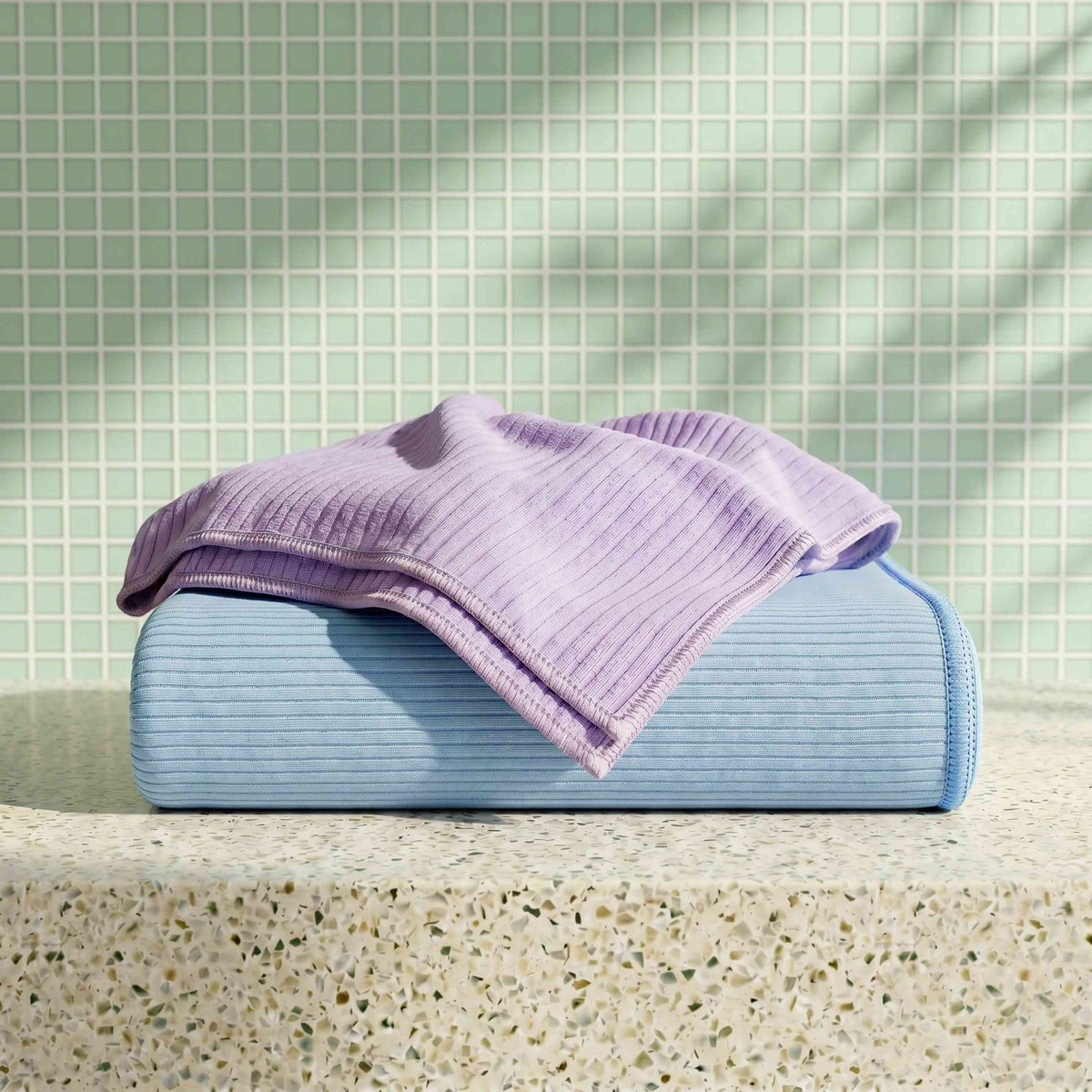
Souverhome Quick Dry Towel Premium Set
A lightweight microfiber towel set designed for people who value portability and convenient drying between uses.
- Material: Microfiber
- Set contents: One large bath towel and one medium towel
- Large towel size: 31.5 × 51 inches (80 × 130 cm)
- Medium towel size: 31.5 × 23.5 inches (80 × 60 cm)
- Listed set weight: 300 g
- Color combination: Sky blue and lilac
- Design details: Reinforced edges, elastic strap, and portable storage bag
- Listed properties: Absorbent, lightweight, soft, and quick-drying
Who should consider it? Travelers, gym users, students, and people with limited drying or storage space who prefer a compact towel set.
Who may prefer another option? Buyers who specifically want the thick, cushioned feel of a traditional plush cotton bath towel should compare cotton alternatives before deciding.
Explore the Quick Dry Towel Premium SetProduct specifications above reflect the supplied product details. Actual drying time depends on humidity, airflow, washing conditions, and use.
If you are comparing materials for a particular lifestyle, start with the intended use. Our guides to whether quick-dry towels are worth buying and fast-drying bath towels for adults can help you weigh drying convenience against feel, size, and maintenance.
Common Mistakes That Make Towels Rough, Flat, or Smelly
1. Adding More Detergent Than the Load Requires
More detergent is not a reliable shortcut to better cleaning. Follow the detergent instructions and account for load size and water hardness. If towels are already coated, adding more product may make the problem worse.
2. Using Fabric Softener in Every Towel Wash
A soft surface is not the only measure of towel quality. If absorbency matters, avoid routine use of products that may leave a coating on the fibers.
3. Leaving Wet Towels in the Washer
Warm, damp laundry can develop stale odors. Move towels to the drying stage promptly and ensure they dry completely before storage.
4. Drying Towels on Excessively High Heat
High heat is not automatically better. Follow the care label and use an appropriate cycle. Repeated harsh drying can shorten the useful life of textiles.
5. Expecting Every Fabric to Feel the Same
Microfiber, cotton, and blended fabrics have different textures and care requirements. A lightweight quick-dry towel will not necessarily feel like a thick hotel bath sheet, and a thick towel will not necessarily dry as quickly as microfiber.
6. Replacing Towels Before Checking the Laundry Process
If several towels become rough at once, review detergent, rinsing, water quality, and drying before replacing the whole set. If only one towel is affected and its fibers are visibly worn, replacement may be the more sensible choice.
Buying Considerations: What Makes a Towel Feel Soft and Fluffy?
When shopping for a new towel, avoid relying on a single specification such as weight, thickness, or a claim of premium softness. Consider the complete ownership experience: comfort after washing, absorbency, drying time, storage, and how much care the material requires.
1. Choose the Material for Your Priorities
Cotton: Often preferred for a familiar, cushioned bath-towel feel. The exact experience depends on construction, quality, and care.
Microfiber: Often chosen for light weight, portability, and quick-drying convenience. Texture can differ substantially from cotton, so choose based on the feel you actually prefer.
Blends: Can balance selected properties, but performance varies with the fiber composition and construction. Read the product specification rather than assuming all blends behave alike.
2. Check Size and Weight Together
A large towel offers more coverage but may take longer to dry and need more storage space. A compact towel is convenient for travel or the gym but may not provide the enveloping feel some users want after a shower.
Weight also needs context. A stated set weight is not the same as the weight of one towel, and a heavier fabric does not automatically prove greater absorbency or longer life.
3. Look for Construction and Care Information
Check seam finishing, edge reinforcement, washing instructions, and whether the manufacturer explains how to maintain the fabric. Reinforced edges and practical storage features can be useful, particularly for towels that travel frequently or are washed often.
4. Match the Purchase to the Real Problem
| Your Main Problem | What to Prioritize | Buying Advice |
|---|---|---|
| Towels feel rough after washing | Fabric quality and manageable care requirements | Correct the wash routine before assuming you need new towels |
| Towels take too long to dry | Quick-dry construction and suitable dimensions | Consider microfiber or another material designed around drying convenience |
| You want a plush, hotel-style bath experience | Comfort, texture, coverage, and construction | Compare cotton options and accept that drying may take longer |
| You travel or use a gym locker | Low weight, compact storage, and fast drying | Look at compact quick-dry sets such as Souverhome's microfiber option |
| Towels have become thin or damaged | Replacement quality and durability | Replace when care no longer restores acceptable performance |
Cost-Benefit Analysis: Improve Care or Buy New Towels?
For a household with several rough towels, changing the laundry routine is usually the lowest-cost first move. Correct dosing, better airflow, and avoiding unnecessary softener require little or no additional spending. If the problem comes from hard water, a targeted solution may be justified after checking local conditions.
Buying new towels makes more sense when the existing fabric is worn, damaged, or fundamentally unsuitable for your needs. For example, a traveler who repeatedly struggles to dry thick towels in a small hotel bathroom may gain more from a quick-dry towel than from purchasing another plush cotton set.
For commercial users, compare total operating cost rather than purchase price alone. Relevant factors include laundry frequency, drying energy, staff time, replacement rate, and guest expectations. A towel that costs less upfront may not be the best value if it wears quickly or requires more drying time. Equally, a premium towel is not automatically a good investment if its care demands do not suit the operation.
When Should You Upgrade?
Upgrade when there is a clear mismatch between your current towel and your daily use, or when the towel has reached the end of its useful life. Do not upgrade simply because a new product promises hotel-like softness. A better laundry routine may deliver the improvement you need without creating more textile waste.
Expert Recommendation: The Best Order of Operations
If your goal is soft, fluffy, absorbent towels, use this priority order:
- Fix the washing process first. Measure detergent, avoid overloaded loads, and rinse thoroughly.
- Remove unnecessary softening products. Give the towel a chance to perform without a coating that may affect absorbency.
- Improve drying conditions. Use suitable heat or adequate airflow, and never store towels damp.
- Investigate water quality. If several towels remain rough despite proper care, check whether hard water is contributing to the problem.
- Replace strategically. Buy a new towel when the fabric is worn or its material no longer matches your routine.
In most professional situations, consistent processes outperform last-minute fixes. The same principle applies at home: choose the correct wash conditions, manage moisture, and match the towel to its intended use. For Souverhome readers, the practical recommendation is to prioritize performance over exaggerated claims of softness. A towel should feel comfortable, absorb water effectively, dry in a reasonable time for your environment, and remain easy to care for.
Frequently Asked Questions
1. What is the biggest secret to keeping towels soft and fluffy?
The biggest practical secret is controlling detergent residue and drying conditions. Use the right amount of detergent, rinse thoroughly, avoid routine fabric softener if absorbency matters, and dry towels completely without excessive heat.
2. Why do my towels become hard after washing?
Possible causes include detergent residue, hard-water minerals, insufficient rinsing, air-drying in conditions with limited airflow, or worn fibers. Check the wash routine first, especially if several towels are affected.
3. Do hotels use fabric softener to keep towels fluffy?
Practices vary by hotel and laundry provider. Commercial operations may use controlled wash formulas and textile-specific finishing methods, but routine softener is not essential for fluffy towels and can affect absorbency. A good wash-and-dry process is more important than copying a single product choice.
4. Should I use vinegar to soften towels?
Vinegar is not a universal solution for towel stiffness. Follow the washing-machine and product manufacturers' guidance, and never mix vinegar with chlorine bleach or other cleaning chemicals. Correct detergent dosage and rinsing are safer first steps.
5. Does fabric softener make towels less absorbent?
Some fabric softeners can leave a conditioning layer on fibers that reduces water absorption, especially with repeated use. The effect depends on the product and fabric, but skipping routine softener is a sensible choice when absorbency is a priority.
6. Is tumble drying better than air-drying towels?
Neither method is always better. A suitable tumble-drying cycle can help some towels feel fuller, while air-drying uses no dryer energy. Tumble drying can increase energy use and wear if the heat is excessive; air-drying can take longer in humid conditions. Follow the care label and prioritize complete drying.
7. Can hard water make towels rough?
Yes, hard-water minerals can contribute to deposits and interfere with laundry performance. If multiple towels become rough despite correct detergent use and thorough rinsing, check your water hardness before buying a treatment product.
8. Are microfiber towels as soft as hotel cotton towels?
Not necessarily. Microfiber and cotton have different textures and performance characteristics. Microfiber is often valued for low weight and quick drying, while cotton is commonly chosen for its familiar, cushioned feel. The right option depends on personal preference and intended use.
9. How often should I replace bath towels?
There is no universal replacement schedule. Consider replacement when towels become thin, damaged, persistently rough, or noticeably less absorbent despite appropriate care. Use frequency, laundering conditions, and fabric quality all influence useful life.
10. Are quick-dry towels worth buying for everyday use?
They can be worth buying if towels need to dry quickly, storage space is limited, or you travel or exercise frequently. If your main priority is a thick, plush feel, compare them carefully with cotton towels. Our quick-dry towel guide for travel can help you assess the trade-offs.
References
The following authoritative resources provide useful background on laundry care, fabric care labels, and energy-efficient drying. Always follow the specific instructions supplied with your appliance and towel.
- American Cleaning Institute — Consumer guidance on laundry products and cleaning practices.
- U.S. Federal Trade Commission: Clothes Captioning — Complying with the Care Labeling Rule — Guidance on care-label information and garment care instructions.
- U.S. Department of Energy: Laundry — Guidance on laundry-related energy use and efficient appliance practices.

Leave a comment
This site is protected by hCaptcha and the hCaptcha Privacy Policy and Terms of Service apply.